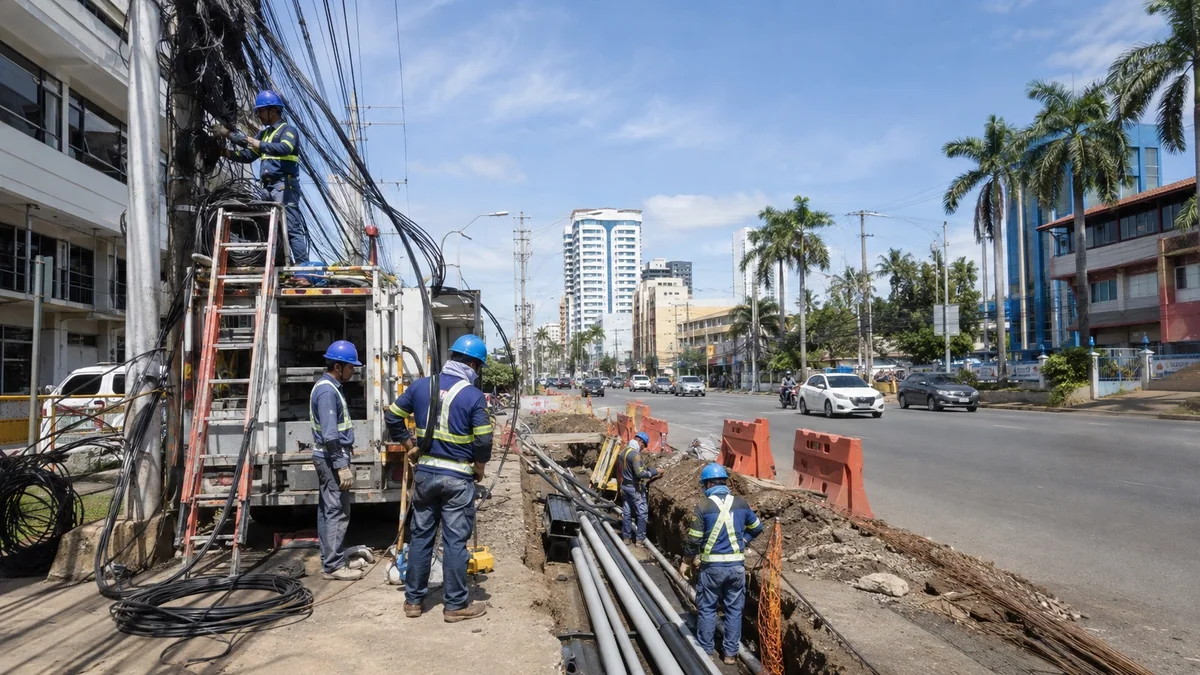
Davao City’s effort to remove “spaghetti wires” and move cables underground is becoming one of the city’s most visible urban improvement projects. For many locals, the impact is easy to see: cleaner streets, fewer messy overhead wires, wider-looking sidewalks, and a safer public space for motorists, pedestrians, and businesses.
The underground cabling project started in key downtown areas and has continued through several phases. According to the City Government of Davao, the first phase covered the City Hall area, while the second phase covered a 600-meter stretch of San Pedro Street. The third phase moved into Magsaysay Avenue and nearby Chinatown areas, covering almost two kilometers of underground cables and removal of overhead wires. City Government of Davao
The budget details are not always presented as one total citywide amount because the project is implemented by phase and involves utility and telecommunications companies. However, earlier reports cited by PIA and Davao Today state that the first phase cost around ₱217 million. Davao Today also noted that under the ordinance, costs for placing electronic and telecommunication wires underground are shared by electric utility companies and public communication carriers, based on the integrated project design. Davao Today
Davao Light has also reported major progress in clearing dangling wires. SunStar Davao reported that Davao Light cleared around 52.25 kilometers of spaghetti wires as of January 2026 and installed 3,990 telco brackets. Priority areas for 2026 included major streets such as Quezon Boulevard, Ebro Pelayo Street, Guerrero, Loyola, F. Torres, Magallanes, Jacinto, Sandawa, Ecoland Drive, Dacudao Avenue, and McArthur Highway. SunStar Davao
For locals, the benefit is more than appearance. Underground cabling can reduce fire hazards, improve road safety, lessen risks from damaged overhead wires, and make public areas more attractive for businesses, tourists, and daily commuters. AboitizPower also noted that underground cabling can help stabilize power and telecommunication services while making the city more appealing to investors and tourists. AboitizPower
In the coming months and through 2027, Dabawenyos can expect the work to continue in phases. Some areas may experience temporary roadworks, traffic adjustments, and sidewalk disruption, but the long-term goal is a cleaner, safer, and more organized city. The project is not an overnight fix, but every completed street shows what Davao City could look like with fewer overhead wires and better urban planning.
City Government of Davao: Underground cabling in Magsaysay Avenue begins
https://davaocity.gov.ph/infrastructure-development/underground-cabling-in-magsaysay-avenue-begins/
AboitizPower: Davao development intensified by underground cabling
https://aboitizpower.com/news/davao-light/davao-development-intensified-by-underground-cabling
SunStar Davao: Davao Light removes 52 km of spaghetti wires
https://www.sunstar.com.ph/davao/davao-light-removes-52-km-of-spaghetti-wires
Davao Today: Fact check on underground cabling budget
https://davaotoday.com/headline/fact-check-davaos-confidential-funds-were-never-used-for-its-underground-cabling-projects/
Philippine News Agency photo reference: Project Update
https://www.pna.gov.ph/photos/80000
Local News
Davao City’s Underground Cabling: Removing Spaghetti Wires for a Cleaner and Safer City
Davao City continues removing spaghetti wires and moving cables underground to improve safety, city views, power reliability, and walkability. The project is being done in phases, with more streets expected to benefit through 2027 and beyond.
By KQUDAH